Show all entries of this category
 After nineteen years in the galleys, Jean Valjean has begun anew—he has acquired a new identity. Monsieur Madeleine is now a respected dignitary. As an industrialist and the mayor of Montreuil-sur-Mer, he dedicates himself to the good of the community and is highly regarded for his generosity, courage and philanthropy. One day, however, his past catches up with him when police inspector Javert arrives to announce the arrest and imminent trial of a certain Champmathieu, a simpleton who is accused of having stolen some apples and who is mistakenly identified as Jean Valjean, the ex-convict. For Jean Valjean’s innocent lookalike the consequences are dire because the theft is requalified as a repeat offense. The misdemeanor is then treated as a crime and is no longer an affair for the misdemeanor division, but becomes an affair for a Criminal Court. Will Madeleine-Valjean allow a poor innocent man to pay for crimes he has not committed? It would be quite easy: he could simply let things run their course. Or will he on the contrary reveal his true identity to clear the man, exposing himself to a reexamination of his entire past and submit himself to trial?
Lire la suite
Philosophers, writers, poets—they have probed the depth of the human heart and opened perspectives on the meaning of life, encompassing both personal and universal dimensions. These “classics” take on particular importance when read again today from a spiritual perspective. For those seeking to nurture their practice of self-perfection, their works abound in living examples, astute observations of psychological or ethical questions, as well as points of wisdom or analogies to ponder.
Lire la suite
“A snake-catcher went to the mountains to catch a snake by his incantations…”. Using this tale recounted by the Persian mystical poet Rumi as a starting point, Leili Anvar introduces here the notion of imperious self.
The imperious self is a central concept in Ostad Elahi’s philosophy. It is this product of the human psyche against which we must relentlessly struggle in order to make spiritual progress, for it is the origin of those of our impulses that systematically and insidiously arise to contradict correct ethical thoughts.
Lire la suite
The principles of a correct education of thought are not matters of intellectual speculation: it is through practice that they bear fruit. But what does putting them into practice actually mean? Bahram Elahi answers this question by pointing out the dangers of overly abstract approaches to practice and self-transformation. It is not enough to consider the principles in theory, or even to self-suggest them daily with the best willpower in the world: in order to “concretely feel” them, we must pitch them against reality.
Lire la suite
No one likes to think of themselves as dishonest. In fact, most of us don’t think they are. Yet who can assert that they have been fully righteous and honest in every situation they have encountered over the past month or year? How can this dichotomy be explained? What is it that pushes us to adopt dishonest behaviours and that shuts down our moral conscience when we do so?
In this insightful and thought provoking talk given at the RSA, Dan Ariely, best-selling author and professor of psychology and behavioural economics at Duke University, draws from experiments conducted among various groups of people in different parts of the world, as well as on personal experiences, to shed some light on these questions.
Lire la suite
As far as spirituality goes, a purely theoretical approach to principles, detached from actual practice, will not do. Not only is it inefficient, it constitutes a genuine impediment to spiritual progress: that of smugness or spiritual “superioritism”. Professor Bahram Elahi spells this out in the following excerpt from a lecture given at the Sorbonne (Paris) […]
Lire la suite
Ostad Elahi delivered the main thrust of his conception of wisdom in a prayer entitled “The Quintessence of Religions”. Leili Anvar chose this angle to shed some light in a concrete and personal way on some of the subtlest aspects of this thought which, while taking root in the mystical tradition, reverses the prevailing trend by replacing reason at its rightful place in the process of spiritual perfection. The question of evil, the meaning of true ethics and true humanness and the importance of faith are among the themes dealt with in this analysis.
Leili Anvar is Lecturer in Persian Literature at the Institut national des langues et civilisations orientales in Paris and a specialist in mystic poetry. This lecture was given on 10 September 2011 as part of a symposium organised by the Fondation Ostad Elahi around the question “What wisdom for our times?”.
Lire la suite
Ostad Elahi used to define his teachings as a new medicine of the soul: one that is adapted to the true nature of human beings and adheres to the law of causality governing both their spiritual and material lives. The spirituality he practiced was natural spirituality, and he considered the process of spiritual perfection to […]
Lire la suite
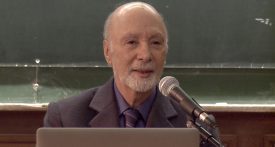
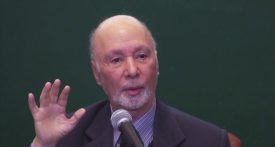
Professor Elahi regularly lectures in Europe and North America. In October 2010, his talk in Paris focused on two key concepts in Ostad Elahi’s thought: self-knowledge and Perfection. Self-knowledge refers to active, concrete, in vivo knowledge of the powers that constitute our being, a knowledge that becomes more refined through the practice of true ethics, based on correct divine principles. According to Professor Elahi, everything else results from this, including the level of development reached by the “metabrain”, as well as the understanding and freedom that one can enjoy here and in the other world.
Lire la suite
The idea of a self-transformative process leading to a better self is probably at the root of spirituality. It suggests the possibility of a higher form of happiness, inseparable from a state of moral perfection, an accomplished wisdom synonymous with true and perfect humanity. This lecture presents a summary of Ostad Elahi’s thoughts on what he calls the process of spiritual perfection. A process that fulfills the purpose of every being, which is to return to its Origin and thus reach the state of Perfection; it is driven by precise laws and dependent on specific means, such as human beings’ voluntary efforts to shape their thought and develop divine virtues.
Lire la suite
Go top
Newer Entries »
|

 News
News Podcast








Recent Comments