Search results for tag "Imperious Self" - 10 answer(s)
This is the first piece in an extended series dedicated to the practice of ethics and more specifically to the identification of the main source of our anti-ethical tendencies: the imperious self. This concept is given a precise definition in The Path of Perfection: “The imperious self is a powerful psychological energy that is harmful for the soul. This energy is continuously produced by the activity of our character weak points, resulting in anti-ethical and anti-divine impulses and desires at the level of our conscious self”.
The paradox is that the fierce resistance deployed by our imperious self against our ethical endeavours actually constitutes the necessary condition for the process of spiritual perfection to take place. In this sense it could very well be considered as our “best enemy”.
Lire la suite
For our intention to become our own “hallowed tree”, it needs to be nurtured and that begins with words. The first stages of what Bahram Elahi calls in vivo practice, i.e. fighting against the imperious self and concretely putting into practice human virtues in everyday life and in contact with others, have to do with our words. The extraordinary thing about words is, precisely, that they are ordinary. Every minute of our lives in the most ordinary circumstances, we can do an act of humanity by choosing to speak or, on the contrary, not to speak.
Lire la suite
Having just celebrated its 10th birthday, e-OstadElahi is launching a new type of thematic series based on “close reading”. The goal is to encourage reflection and interaction around key concepts from Ostad Elahi’s thought through collective analysis and discussion, both from a theoretical standpoint and with a view to drawing practical conclusions. The recent publication, in French, of a new edition of The Path of Perfection (La Voie de la Perfection) by Bahram Elahi provides an ideal resource and reference text for such a project.
Lire la suite
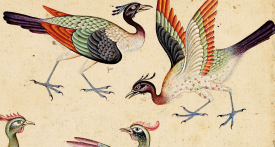
This article is part of an ongoing series on Attar’s Canticle of the Birds (also known as The Conference of the Birds), a spiritual text rich in lessons for spiritual practice. For more information about the book and its author, please refer to the first article in this series entitled “The nightingale and the rose: from attachment to renouncement”.
The focus of this article is on our most intimate enemy: the imperious self. Here is how it is portrayed by Attar…
Lire la suite
After reflecting on the question of God and what “putting one’s faith in that One” truly means, we continue here our series on Ostad Elahi’s poem “The Quintessence of Religions” with a second excerpt from Leili Anvar’s commentary of this text, which was originally published (in French) in the proceedings of the symposium “Quelle sagesse pour notre temps ?”. This second excerpt examines the question of “evil”.
Lire la suite
According to Ostad Elahi’s model of the self, we are bi-dimensional beings. We carry within ourselves a celestial part that, combined with our animal terrestrial part, forms our humanity. It is within this intimate combination—perhaps best compared to fertilization (when two gametes, or sexual cells, one male, the other female, unite to form a new zygote)—that our psychological and spiritual personality is forged. It is a crucible for our character traits and for the powers within us. In this equation, also lies the enigma of free will, in other words the question of evil
Lire la suite
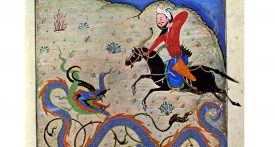
“A snake-catcher went to the mountains to catch a snake by his incantations…”. Using this tale recounted by the Persian mystical poet Rumi as a starting point, Leili Anvar introduces here the notion of imperious self.
The imperious self is a central concept in Ostad Elahi’s philosophy. It is this product of the human psyche against which we must relentlessly struggle in order to make spiritual progress, for it is the origin of those of our impulses that systematically and insidiously arise to contradict correct ethical thoughts.
Lire la suite
This article was written by Scr, a regular contributor to the e-ostadelahi website. It gives an account of what ethical practice can be like for those who seek to progress on the path of perfection. The two everyday scenarios presented here help provide insight into our actions and thoughts. Whether we share the author’s conclusions or not, his approach is in our opinion worthy of interest; it is an introspective self-analysis that results in an awareness of one’s emotions—a stepping stone toward ethical readjustments of our thoughts and behaviour.
Lire la suite
Family life is filled with delights and annoyances that are felt particularly deeply within the couple itself. The hypothetical case study of “Jack and Kelly” offers an illustration that many of you have commented on. What if living together provided a sort of ethical laboratory for each of the partners? This is the idea proposed in the following text. In order to develop this hypothesis, the author of the article briefly recalls the conditions for a successful practice of ethical principles, as well as the operational modes of the imperious self according to Ostad Elahi. Then you will be invited to give further thought to the matter by taking part in a quick poll based on your own personal experience.
Lire la suite
Why does self-knowledge matter? How and why is it connected to the practice of ethics? Elie During, Associate Professor in the Philosophy Department of the University of Paris – Ouest Nanterre, addresses these questions in an article published in a special issue of the Annals of the New York Academy of Sciences entitled “Perspectives on the Self”.
In the following excerpt, the author examines Ostad Elahi’s concept of the “imperious self”, emphasizing the importance of self-modeling in the process of self-transformation.
Lire la suite
« Prev - Next »
|

 News
News Podcast









Recent Comments